


*Responsibly
What can Aldi, Lidl and KFC teach us about being relevant on social media?
Oh, so much, dear reader. So, so much.
Once upon a time…
Back when the artist formerly known as Twitter was a playground for book nerds, and the only pics you’d see on Insta were of retro-filtered sunsets, brands used social media to announce new products, share the occasional inspirational quote and wish everyone a happy Bank Holiday weekend.
How wholesome, how whimsy, how woefully unchic of us all.
Well, those simple days are gone.
And in their place is an overload of elaborate GRWMs, mind-numbing doomscrolling, and of course a loadsa FAKE NEWS.
So, when something so side-splittingly lol pops up on our feeds, and when that lol happens to be from an unlikely source, in an unlikely format? Ooof, it’s worth shouting about, is it not?
We hope you like your beef well done.
Let’s be real. In the current digisphere, the only way for a brand to cut through on socials – without paying an ex-Love Island finalist to #ad it – is to be decidedly devil-may-care about it all.
Enter Aldi, Lidl and KFC. Three brands proving that a sharp wit, a finger on the cultural pulse and a willingness to be a little bit silly can go a very long way.
A caterpillar, a court case and a commitment to being petty.
Let’s start with one of the greatest domestic dramas of our time, Cuthbert vs Colin.
Forget The Traitors, and move over Meg-sit, because in 2021, the nation was gripped by a legal dispute involving two chocolate caterpillars.
In short, Marks & Spencer took legal action against Aldi over its Cuthbert the Caterpillar cake, claiming it infringed the trademark associated with its beloved Colin.
A sensible corporate response might have involved a carefully worded statement, a few meetings with the legal team and a lot of people frowning into their chins in a boardroom.
Aldi had other ideas.
And so, #FreeCuthbert was activated.
Aldi dubbed its rival Marks & Snitches in a series of unhinged tweets,* put darling Cuthbert behind bars, hijacked M&S’s infamous ‘This isn’t just any’ tagline, bagged a 30% increase in followers, reached more than 35 million people on Facebook, and generated over £5 million in organic media exposure. All without paid media spend.
Not bad for a cake with a face, eh?
The way the social team then subsequently ran with the campaign swiftly cemented its reputation for being cheeky, quick-witted and a whole lotta petty. And all in 75 characters or less.
Since then, the store’s social team has become the blueprint for how nonchalance, a Gen-Z attitude to beefing, and some crude Photoshop-ing can take a supermarket a long, long way.
Here are some recent faves that have kept us chuckling:
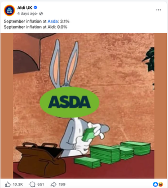
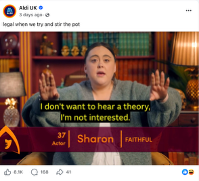
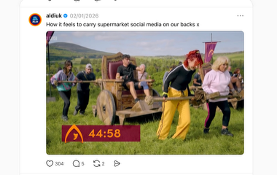
One potato. No crumbs left.
If Aldi is the reigning champion of punching-up comedy, Lidl deserves an award for knowing exactly when to insert itself in the conversation.
In 2024, Liam Gallagher appeared in a Berghaus campaign wearing a jacket in a very familiar blue, yellow, and red combination, and those chronically online were quick to point out that he looked like he’d wandered straight out of the shop’s middle aisle.
Lidl spotted the joke, doubled it, and won big.
Directly beneath the giant Liam Gallagher mural in Manchester, Lidl placed an advert for a 24p jacket potato.
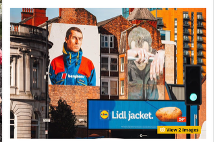
The headline? Lidl Jacket.
GENIUS!! Chefs kiss. Truly excellent work. The stunt alone generated millions of impressions and over 155,000 engagements. But the real magic was how that same attitude is seamlessly embedded in Lidl’s everyday content.
Case in point:
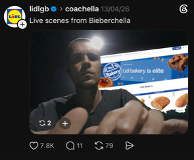
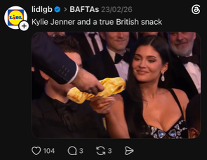
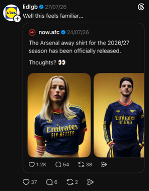
If something is happening in pop culture, Lidl will find a way to make it about them in a way that seems effortless, or even accidental.
Of course, that apparent lack of effort is deceptive. The team needs to understand the reference, recognise why a crudely dropped-in image is funny, judge whether the brand can join in and get the timing right.
Which is rather more skill than it takes to schedule another stock image of a shopping trolley.
Beautiful.
Sometimes your chips are rubbish, and that’s ok.
KFC’s chips are c***p. Always have been. The Colonel did not prioritise making the perfect crispy, salted, saturated-fat potato stick, and quite frankly, it shows.
Yet, rather than ignoring the criticism, KFC decided to own it. And when it launched its new Signature Fries, it leaned straight into the complaints.
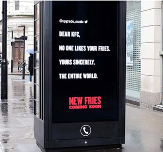
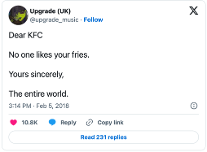
The campaign acknowledged that the old fries hadn’t been up to scratch, used some sweary wordplay and reached out to previously disgruntled customers to encourage them to give the new version a try.
It was bold, self-deprecating and refreshingly free of the usual corporate nonsense. And it worked. A WARC case study reported a 112% increase in app sessions and a 2,000% increase in fries purchased among key customer segments during the campaign.
And that’s because KFC’s social team has long been the OG’s of giving us some finger-lickin’ lols.
Remember the great chicken shortage of 2018?
When supply problems forced hundreds of UK restaurants to close (because of corporate greed, one must note), KFC responded with its now-famous FCK advert, rearranging the letters on its bucket to deliver a perfectly pitched apology.
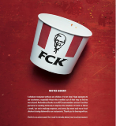
KFC understood a long time ago what a lot of brands find uncomfortable: your customers already know when you’ve messed up, so join them in the pile-on.
Again, it’s not just the big face of a campaign we’re interested in. It’s the attitude behind it. KFC’s social personality is built around a willingness to be cheeky, self-aware and posting from the trenches. The marketing response might kick things off, but it’s the doggedly erratic social team that bags the win.
So, what’s the secret? (Spoiler: it isn’t posting more.)
Aside from carbohydrates, there is something else linking these three titans of content: they understand social media is somewhere people go to have a laugh.
Their posts don’t feel like they’ve been dragged through rounds of approvals, stripped of every weirdly wonderful human thought, and scheduled six weeks in advance.
That’s not to say there isn’t serious thinking behind it. There absolutely is. But that thinking is a faith in the team, their creativity and their commitment to living and breathing the zeitgeist as they actually live it. And it’s this that allows these huge corporate brands to thrive in a space that otherwise wants to ignore them.
They pay attention to what’s happening outside of an overdone marketing trend.
And, perhaps most importantly, they trust the general public to have a sense of humour too.
More personality, please.
Now, we’re not suggesting every business should immediately pick a fight with its competitors. Seriously, please don’t.
And not every brand needs to be funny, sweary or spectacularly unhinged.
But there is something worth taking away from the way Aldi, Lidl and KFC approach social media: remember there are actual humans on the other side of the screen.
So, here’s to the social teams keeping things interesting. The quick thinkers, the excellent troublemakers and the people brave enough to press ‘post’ on something genuinely funny.
Long may the beef continue.
And if you need help finding your voice or image online, we’ve got a few people who might be able to help.